Showing posts with label Jay Li. Show all posts

Sunday, January 7, 2018

Chess: Typical Openings (Part 2)

Eade, James. “Selecting Your Strategy: The Principles of Play.” Chess for Dummies, John Wiley & Sons, 2016, pp. 191–225.

In my first blog, I talked about typical openings and how you should control the center. This time I will be revisiting those ideas but also expanding on them. Controlling the center or centralization is something that gives you a positional advantage. According the James Eade, "A positional advantage isn't the same as a material advantage or an advantage in pawn structure. This type of advantage provides a player with a more subtle edge than other advantages and can evaporate quickly as a result of inexact play" (Eade 201). This means that controlling the center only gives you a minor advantage but nonetheless it is still an advantage, which means it will help you win. In my first post I only mentioned that you should control the center, but here are some common openings with steps

This is the French Defense. After white moves a pawn to e4, black moves a pawn to e6 . This means black will contest for d5, controlling part of the center.


This is the Indian Defense. After white moves a pawn to d4, black moves a knight to f6. This means black will control the center squares d5 and e4.


This is the Ruy Lopez or "The Spanish Game". After a double king pawn opening (white pawn to e4, black pawn to e5), white moves their knight to f3 (to capture the black pawn), then black moves their knight to c6 (to capture the white knight after it captures), and then finally white moves their king's bishop to b5 to threaten the black knight to retreat, taking control of the center.


The next topic is how to control the center, development is the key. Development is the "rapid mobilization of chess pieces" and technically either side isn't developed until all the pieces have moved off their original square. To control the center during the opening, it's not a good idea to exchange pieces or to try and check the enemy's King. Instead save the opening moves for development, try to get all the pieces to the most optimal position (Eade 210). However, it is not worth it to develop a piece to it's optimal square if the piece will get contested and be forced to move back. Overall, to control the center it's necessary to remember the few principles of opening play. Don't exchange pieces, avoid moving to squares where the piece will be driven off, and try to develop all your pieces.

Question: How much about your subject have you learned so far?

Friday, December 29, 2017

Chess: Pawn Formations and Sacrifices

Eade, James. “Sacrifices: Understanding When It's Better to Give than to Recieve.” Chess for Dummies, For Dummies, 2016, pp. 125–187.

Sacrifice is the act of giving up something for another thing of higher value. However, in chess a sacrifice is the intentional lost of a valuable piece. Here is an example that you might believe is a sacrifice but it is actually just a trade, capturing the enemy's queen at the cost of your knight. Although, every move in chess could be considered a sacrifice (a sacrifice of space or material) for a lead in development. That means that there are many types of sacrifices in chess from temporary to permanent. One of the most important types of sacrifices are gambits, "We refer to sacrifices that occur in the opening phase of the game as gambits. Gambits almost always involve the sacrifice of material for a positional advantage" (Eade 127). The reasoning for gambits is if you can get into an attacking position quicker you can win back the sacrifice.


The images above show a simple sacrifice or gambit. After I moved my pawn from f2 to f4, the enemy pawn captured my pawn. By sacrificing my pawn I gained control of the center square d4 (also as I mentioned in my previous posts having control over the center gives an advantage).

The next subject is pawn formations, different arrangements of pawns can change the game. According to the book, pawn formations have been tested and they do give you an advantage when used correctly. Pawn formations will also help the player understand where pieces should go to complement another (Eade 157). Recognizing enemy pawn formations can also help you counter them.  Here is an example of the Stonewall Formation, in this formation you guard the center and attack the sides. So, by memorizing the popular ones (and their flaws), you'll have an advantage against some of your opponents.

Question: Do you think sacrifices are required for success?

Sunday, December 24, 2017

Chess: Notation and Forks

Eade, James. “Got Notation? Reading and Writing about Chess.” Chess for Dummies, For Dummies, 2016, pp. 85–125.

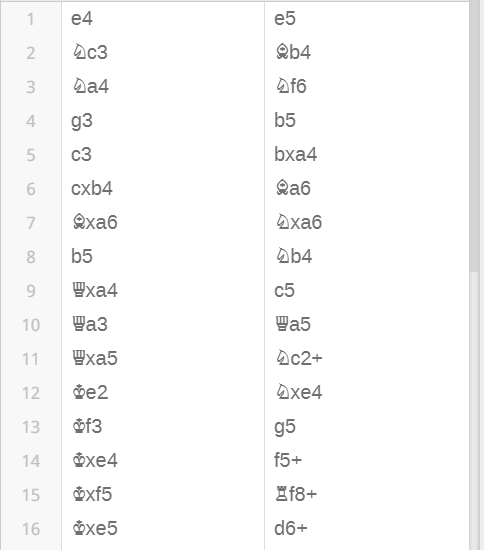
As I continued to read my book Chess for Dummies I've learned new suggestions for the game such as keeping a written (chess notation) record and aiming for 'forks'. The book states that, "Chess notation has an important role in the world of chess because it preserves the game's history" (Eade 85). Although, Chess notation may not have an effect in a causal game, it's still good to know about. In official chess competitions, you are required to mark down every single move you make in chess notation. The reason is chess notation can help settle disputes and reconstruct the game. Even though I don't plan on playing in any competitions, I still payed more attention to the chess notation.

Here is an example of algebraic chess notation. There are other notations such as Forsythe, but algebraic notation is universally understood. Algebraic notation is often a letter (except the pawn) accompanied by the square (Column letter and row number). Each 'Move' contains a white move (recorded on the left) and black move (recorded on the right). Overall, learning about chess notation has helped me understand moves better.


The definition of tactic in chess is a single move or a series of moves that gives you an advantage (Eade 100). An example of a tactic is the fork. A fork is when you use one chess piece to threaten two enemy pieces. As you can see in the example my knight threatens both enemy pawns, which is a knight fork. Although, it's simple strategy it gives you a big advantage since your opponent can't always protect both pieces. So, how important do you think tactic is to chess?

Monday, November 27, 2017

Chess: Typical Openings


Eade, James. “Exploring the Elements of Chess.” Chess for Dummies, For Dummies, 2016, pp. 39–42.

Before starting the book Chess for Dummies by James Eade, I had no clue on how to play chess. Sure, I may have known how pieces moved from playing on the chess program that's sometimes pre-downloaded on the laptop but that was it. With no chess knowledge on strategy or combinations I lost to computers in chess almost every single time.

After reading the first 5 chapters of the book, I've learned a lot more about chess. One of the tips that caught my eye was this, "The battle for space is fiercest in the center of the board. Controlling squares e4, e5, d4, and d5, as well as the squares adjacent to them, is like seizing the high ground in a skirmish" (Eade 40). Space is extremely valuable in chess, as chess is a game of "Spacial conquest" (Eade 39). Space can force you or an opponent into a cramped position leading to checkmate. I followed the tip and began with a with this opening. Two pawns and two knights forward, competing for the area in the center.

In this position, I realized how much control over space I had. My knights and pawns could easily capture any enemy piece that wandered too far. The bishops in the back row were free, not blocked by my pawns. Before attempting this opening, I never realized pawns blocked the potential of other pieces or the fact that some pawns should specifically be moved first. Pawns on the "wings" or sides of the board should not be moved first, pawns blocking pieces that move diagonally should be removed first to gain control in the "opening" stages. Although I lost this game, I gained some understanding on how moves could compliment other pieces and how space is essential in winning.

Question: Have you ever learned something crucial through actual practice rather than reading?