Showing posts with label skiing. Show all posts

Wednesday, January 10, 2018

Skiing: Powder Skiing

Power skiing 

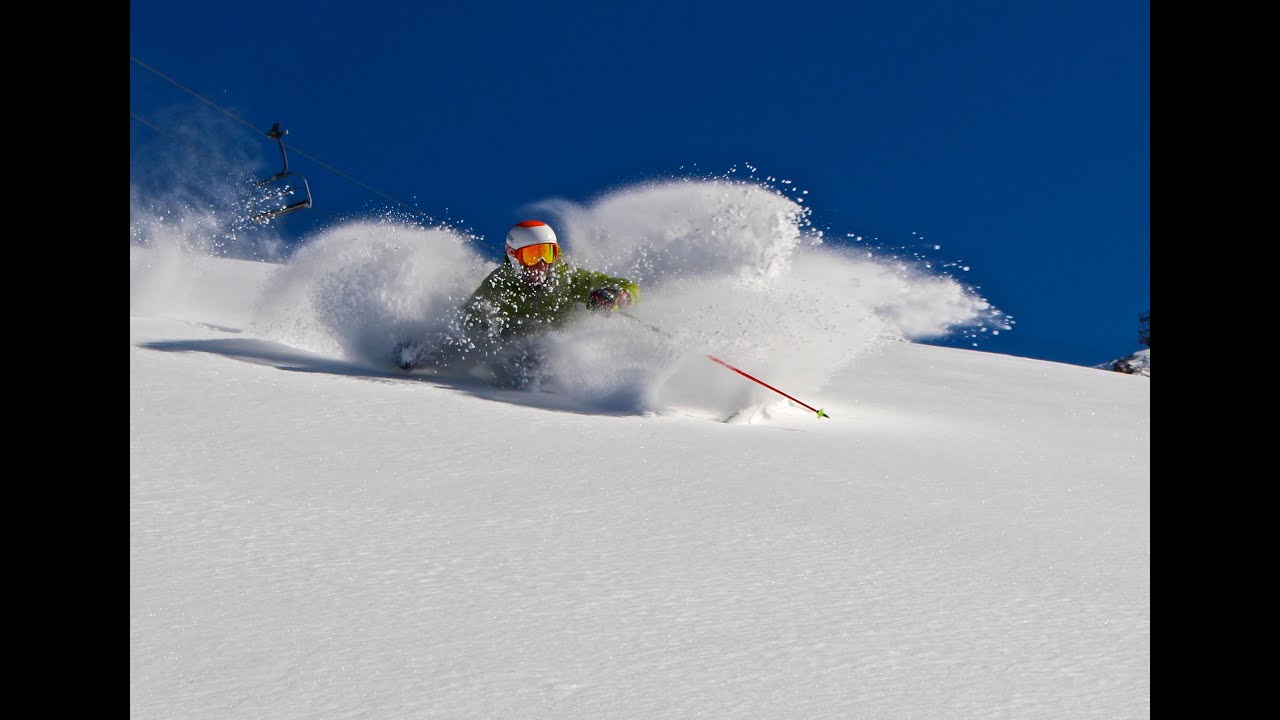
Image result for powder skiingSkiing powder snow is a very personal experience, as you develop an intimate relationship with the snow and the mountain. It is clearly exciting, exhilarating and pleasurable. I feel that powder skiing is to skiing as ballet is to dance, for it requires an artistry and finesse of movement, coupled with a strength of the body and fluidity of motion. 
The basic turn for powder skiing is the short- swing turn I described in my previous blog. All that is necessary to use this turn in powder is to modify the body stance and weight distribution and exaggerate the flexion-extension-flexion movements. Once you know how to do this, the next step is to experience the feeling of ridding on a soft cushion beneath the skis rather than on a solid surface, and overcoming the fear of not being able to see your skies under the snow. 

Image result for powder skiingTo learn how to ski in powder i therefore recommend that you first learn the modified body stance and then practice traversing and turning uphill in deep snow to experience the feeling of ridding on a soft cushion. 
Powder skiing is mostly for advanced skiers, mostly because most powder trails are for advanced and experts due to the fact that the grooming machines can't go on trails that are too steep. 


There is also another turn specifically done on powder snow called the The Powder Turn. 
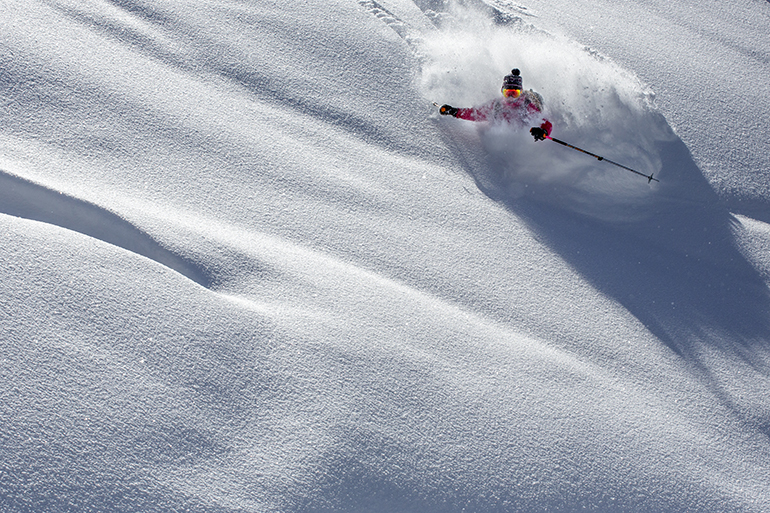
Image result for deep powder skiingThe powder turn is a very tireless way of skiing. The powder turn does not cause the skis to turn rapidly across the fall-line, this turn does not slow you down as much as most other turns do, and hence is best skied on intermediate-grade slopes in powder which is at least knee deep or on steep resistance of the snow against the body is used to prevent you from going too fast.
"The powder turn makes use of momentum and the pull of gravity to help get the skis through the turns, and hence is most often used when skiing quickly or dynamically" (Heckelman, 172)

Skiing: Advanced Skiing turns

In advanced skiing turns start to become faster and shorter radius'. When skiing on advanced trails you need to make smaller turns so you keep your balance and you don't put too much pressure at a time on a leg because that can cause a lot of pain the next day. As I said before in beginner skiing you learn how to use the upper body for balance and the lower body for skiing. Now in advanced skiing, the upper part of the body is always facing down the fall-line and remains relatively still while the work of turning and steering the skis is done by the feet, ankles and knees. In advanced skiing, there are different types of turns to help you get down the trail.

These turns should be practiced on beginner's slopes to get used to the movement of the turns without getting out of control on the slopes.

Image result for short swing turns skiing description1. Short-swing Turns (Steeps)- turns performed on a downhill run the enables you to take the slopes at a steeper angle. At first the turn is done with the skis kept very wide apart and with exaggerated flexion-extension-flexion under-weighting movements and then as you become more at ease with the maneuver, the skis are brought together and the amount of flexion-extension-flexion is substantially reduced.


2. The counter-turn (S turn)- On a steep slope, a very useful maneuver for controlling your speed without losing your smooth rhythm is the counter turn. In this movement, you use your knees and ankles to steer your skis up the hill just prior to executing a downhill turn. By turning your skis up the hill, you slow them down. Since the skis are continually turning on their edges, this is a smooth way of controlling your speed without slide-slipping.

Image result for Wedelen turn skiing
Wedeln Turn
3. Wedeln Turn- This turn is essentially a short-swing turn executed quickly with the skis held close together, the weight on both feet at all times, very little down-up-down movement and with very little edging. This turn is mainly done on gentle, smooth slopes. The Wedeln turn is basically hoping on your skis as you make a turn.


4. The Jet Turn- The Jet turn maneuver teaches you how to bring your weight forwards again and regain control so that you can end the turn in a correct position, leaning against the fronts of the ski boots. The Jet turn is also an enjoyable ski maneuver when you're playing around on the slopes.

"The key to making good turns is to allow the skies to turn, not to force them" (Heckelman, 87)

Saturday, December 23, 2017

Skiing: The Terrain Park

The Terrain Park is a place for freestyle skiing while doing tricks and jumping 5-100 feet in the air. The Terrain Park is more advanced skiers and not everyone wants to do it. The Terrain park takes years and a lot of practice to make a successful jump. The Terrain Park has many different obstacles to perform many tricks. There are mainly 3 types of obstacles to do tricks and each is divided into other types of obstacles.
This video shows the many different types of tricks done in the Terrain Park

1. Jigs-  Jigs are types of fixtures which can be ridden with the board or skies parallel or perpendicular to the snow surface, ridden while spinning around on or ridden and jumped or tricked from. There are many types of jigs, some being:
            - Rails
            - Box
            - Table top
            - Trees
            - Park Bench or picnic table
            - Walls
2. Jumps- Jumps can range from 5 feet to 100 feet and above. Jumps are most often entirely of snow or snow with a base of dirt. Jumps are used to do tricks such as grabs, twists, spins and flips. some type of jumps are:
Image result for halfpipe skiing
Half-pipe
           - Tabletop
           - Step-down
           - Step- up
           - Gap
           - Hip
           - Spins
          - Channel gap
3. Verticals
           - Half- pipe 
Image result for terrain park
A type of Jig
           - Quarter- pipe

"Doing tricks in the Terrain Park takes years of training and if you are interested in do it, you have to start with small jumps and move your way up to bigger jumps"(148) says Martin Heckelman.
Image result for terrain park jumps
Jumps

Skiing: Beginner Turns

In skiing one of the most important things are the different types of turns. As a beginner it is important to know all the basic turns because different types of snow require different turns. Most of these turns are part of the International Parallel Technique I wrote about in my last blog. As a beginner all these turns should be perfected on gentle slopes before you go on more intermediate slopes. Once you feel comfortable with the turns on easy slopes then you can move on to harder slopes. Just remember a skier is not a skier without falling millions of times. If you are afraid of falling than skiing might not be a sport for you. I've been skiing for about 6 years and throughout the years i have probably fallen so many times that if you gave me a dollar for every fall I will be a millionaire, so don't be afraid to fall, it's just snow. If you expect not to fall than you are sadly mistaken. The truth is the first time you get on skies you probably will fall within the first 5 minutes.
There are many types of turns so I'll go over the most important ones that are necessary to learn while skiing.

Related image
Wide- Track Pressure Turns
1. Uphill turns- Uphill turns are usually used to stop when on a slope. How this maneuver is performed is when you want to stop you have to put pressure on on leg and you'll make a turn but keep putting pressure on that leg until you start going up the hill and you'll notice that you are stopping. usually if you give a lot of pressure you'll stop immediately.
2. Wide- track pressure turns- Usually beginners start with wide- track turns and go into short-radius turns. Wide- track turns are usually performed but putting pressure on one leg and then go across the slope and but pressure on the other foot to make another turn and you repeat that until you get down the slope.
Image result for skiing- uphill turns
Short- radius pressure turns
3. Short- radius pressure turns- Short- radius turns are really similar to wide- track turns but in short- radius turns once you put pressure on one leg and you make the turn you immediately put pressure on the other foot to make another turn.
4. Parallel turns- Parallel turns are similar to short- radius pressure turns but in this type of turn you also use your poles to turn. You do what you do for short-radius turns and while turning you put your pole in the snow and kinda use the pole to help you turn. It's like going through obstacles.
Image result for skiing-  parallel turns
Parallel turns
These are the 4 most important turns to know when skiing. "These turns are like the foundation to further skiing techniques"(Heckelman, 87).

Monday, November 27, 2017

Skiing: The international Parallel Technique

I've been skiing for around 6 years and when i was learning how to ski my dad aught my sister and me from his own experiences but he never knew there were many techniques for beginners. The International Parallel Technique (TIP) teaches you how to do smooth turns on an easy intermediate slop at the end of 5 days. Each is divided into 2 sections: morning and afternoon exercises. Each day focuses on different techniques for skiing. By the end of the 5 days if you followed the instructions you should be able to ski down an easy intermediate slope (a blue slope).

"The goal of the International Parallel Technique, which is described in this section, is for you to be making an easy intermediate slope at the end of five days" (Heckelman, 19).

Day 1- morning: beginner exercise
            afternoon: traverse
Day 2- morning: sidesliding
            afternoon: skating and learning to ride ski lifts
Basic downhill turns
Day 3- morning: uphill turns
            afternoon: pressure turns
Day 4- morning and afternoon: parallel turns downhill
Day 5- morning: linked parallel turns on gentle slopes
            afternoon: linked parallel turns on intermediate slopes

As you practice these exercises to develop basic skills, you at the same time perfecting advanced skiing capacities.
Basic skills to get comfortable on the skies