Showing posts with label chess. Show all posts

Sunday, January 28, 2018

Chess: Slav Defense

By: Alex Faull


Queen's Gambit, common
and complicated.
The queen-pawn opening is one of the most common openings in chess, and has many kinds of strategies that stem from it. One of the most common strategies for white is the Queen's Gambit, which can be seen in the image to the right. Now. while Black might be tempted to capture White's c4-pawn, it is much better to hold the center and defend the d5-pawn. One of the many defenses of the d5-pawn is known as the Slav Defense.

Slav Defense: Black responds
to the Queen's Gambit by
using the c-pawn to defend.
The Slav Defense (image on the left) comes from a very simple move: moving the c7-pawn to c6. A solid defense, since protects the d5-pawn. After this move is made, White has two options: trade pawns by capturing the d5-pawn with the c4-pawn, or defending his own pawns. There isn't any huge downsides to trading pawns, but by trading pawns Black is given the opportunity to move the b8 knight to c6, threatening to take White's d4-pawn.

For defending, Yasser Seirawan shows a few options White in his book. Winning Chess: Openings. According to Seirawan, "The preferred way to meet the Slav Defense is to protect the c4 and d4-pawns." The method of defending both pieces presented by Seirawan is effective as well as simple. It's a single move in fact. By moving the e2-pawn to e3, White defends both pieces. The e3-pawn is defending the d4-pawn, while the f1-bishop defends the c4-pawn. With one move White has secured both pawns and his foothold in the center, making it incredibly difficult for black to push White out of the center, especially since Black's b8-knight can't move to its preferred c6 spot.
Response to Slav Defense suggested by Seirawan. The e3-pawn defends the d4-pawn, and the f1-bishop defends the c4-pawn. This holds the center position, and allows the c4-pawn to safely threaten the d5-pawn.
I tried Seirawan's way of dealing with the Slav Defense against a chess AI, and while I still lost, I liked the strategy quite a bit, since my defense was only broken because of a handful of dumb mistakes. If I had played better, I could've held the center of the board for much longer.

There are many responses to the Slav Defense, either revolved around weakening Black's hold the center through trades, or strengthening White's own hold on the center. Your choice of response is determined by how you answer the following question: Is is better to fortify your own center pieces, or remove your opponents center pieces?

Work Cited:
Seirawan, Yasser. Winning Chess Openings. Gloucester Publishers Ltd, 2003.

Chess: The Petroff Defense

By: Alex Faull

In chess, white always moves first, which causes black to usually take a more defensive approach to the game. Because of this, black will spend its first few moves defending its center pawn (see previous posts for information on center pawns and their importance). However, sometimes one might choose to attack in order to defend, and choose to use The Petroff Defense.


The defining move of The
Petroff Defense, Nf6.
Very typical and solid opening
position for white.
To the left is pretty average early king-pawn opening position. White has moved a knight to f3, threatening take Black's pawn and also defending the d4 square. To the left, we have one of the possible responses to white, The Petroff Defense. Yasser Seirawan sums up the logic behind this defense quite well in his book, Winning Chess: Openings. He says, "Instead of busying himself with the defense of his e5-pawn, Black counters with an attack of his own against White's e4-pawn"(Seirawan, 40).


While defending the e5-pawn is a solid option, threatening White's e4-pawn also is solid. Black is basically giving up his own center pawn so he can attack his opponents center pawn when he uses The Petroff Defense. Because of this, both pawns, as well as a few other pieces tend to get traded when this defense is used. What pieces get traded is mostly impacted by White's first move after black first threatens the e4-pawn. According to Seirawan, White's best to options are capturing Black's center pawn with the knight at f3, or moving the pawn at d2 to d4, putting another piece into position to attack Black's e5-pawn.

An important thing I learned about The Petroff Defense when using it against a chess AI was that it only works effectively on king pawn openings. There isn't a queen and king Petroff Defense, just the king Petroff Defense. This is mostly because in a queen pawn opening, the pawns are defended by the queens, so trying to be aggressive and attack White's pawn doesn't work as well, since it comes with that defense.

The Petroff Defense is a very solid defense, but it usually will cause pieces to be lost on both sides. So the question you need to ask yourself when using this defense is as follows: is it worth sacrificing your own pieces in order to take opposing pieces?

Work Cited:
Seirawan, Yasser. Winning Chess Openings. Gloucester Publishers Ltd, 2003.

Thursday, January 25, 2018

Winning Chess Tactics "The Decoy"

One of the last tactics that Yasser Seriwan taught was "The Decoy" The title probably gives it up, but this is the most satisfying trick in chess. This also makes the game go by faster too. Yasser Seriwan states "The idea is simple: If you find yourself wishing that one of your opponent's pieces were on a particular square, you must find a way to force him to move there." Decoy is a tactic involving a sacrifice to force the opponent's piece to the poisoned square.
In this picture, you can see that the bishop was moved right next to the king. So, the point is that the opponent attacks the bishop and will be inset for a plan to get checkmated.
One of the fundamentals of chess his to make sacrifices and this tactic of sacrifice is perfection. I have been doing this tactic for a while and it works. Yasser also added "...it's often useful to visualize the position you want and then do your best to create it (always bearing in mind that your opponent will not willingly cooperate). Naturally, the sacrifice is the prettiest kind of decoy. However, some other enticement will often do the trick." This trick is one of the best is so when playing chess this will do the trick and takes the least amount of time.

Winning Chess Tactics "The Deflection"

Yasser Seirawan addresses another tactic for you to close a chess game. Yasser Seirawan talks about how to quickly close a game at the end of creating chaos between there pieces. He adds "...you might find yourself on the brink of victory, except that your opponent clings to life as hard as he can. As often as not, his tough defense is made possible by one hard-working piece that is somehow holding everything together." So basically, it is a tactic that forces an opposing piece to leave the square, thus exposing the king or a valuable piece.
In this picture, the Queen is moved two spots left exposing the castle wide open making the opponent attack, leaving less defense on their King side making it easier to checkmate 
I would agree with Yasser as he asserts that "To break down such a position a position, you need to chase the defender away from the critical area in the hopes that the defense will then fall apart." He has a solid point to break down the opponents defense. This method is the easiest way to checkmate the king and win the game with skill.

Winning Chess Tactics "The Skewer"

Yasser Seirawan expresses another tactic to take down your foes in chess. This tactic is known as the pin in reverse. Yasser Seirawan goes into detail and says "A skewer has been likened to pin in reverse. With a pin, the attacker's objective is to win the pinned piece or the more valuable piece behind it." So, the difference between a Pin and a Skewer is that the more valuable piece is in front of the piece of lesser value.
The opponent has to move the king to save it or else it gets captured and in chess when the king gets captured that means the game is over. So, the queen is checkmating the king and the opponent has to move the king. When he moves the king, your queen has a direct shot at the opponents queen.
I honestly use this trick the most or this usually happens when I don't even realize that I have done the skewer. I'm usually playing with my family, heading into the final turns of the chess match and trying to checkmate the king, but out of nowhere I check the king and when he moves the king it leaves a wide open strike for me to attack the piece on the other side. Like Yasser said "With a skewer, the attacker objective is to threaten a valuable piece so that it is forced to move, allowing the capture of a piece behind it."

Winning Chess Tactics "The Pin"

Yasser Seirawan introduces another flawless tactic to take your game of chess to another level. This tactic is called "The Pin". Yasser elaborates more by saying "When you attack a piece that your opponent cannot move without losing a different piece of greater value, you are pinning the first piece. When the piece of greater value is the king, this tactic is called an absolute pin; when it is not the king, the tactic is called a relative pin." He continues to talk about a pin is a situation brought on by an attacking piece in which a defending piece cannot move without exposing a more valuable defending piece on its other side to capture by the attacking piece.
If you set the bishop at D5 and the opponent tries to remove your bishop then the queen will be removed because your queen will kill his queen making a good sacrifice.


I have always been using this trick, mostly when my opponent is not paying that much attention to the surrounding. I will usually take out of his guys so the opponent attacks back, but they don't realize that I have another piece ready to attack if they attack my piece. A lot of chess players probably already knew this trick just like Yasser Seirawan said: " Pins occur during all phases of the game, but they are most common in the game."

Winning Chess Tactics " The Double Move"

Winng Chess Tactics is written by Yasser Seirawan and with Jeremy Silman. Yasser Seirawan is an american chess grandmaster and a four time United States champion from Seattle, Washington! He has won the World Junior Chess Championship in 1979.
Yasser Seirawan

The Double Attack has bigger chances of causing a weakens in your opponent's game
 In the beginning of the book, Yasser Seirawan introduces his very first tactic the "Double Attack" he says "A double attack, as the name implies, is an attack against two pieces or pawns at the same time. Beginning players quickly learn that a simple attack against a single enemy piece or pawn can easily be countered in a variety of ways." He continues to talk about this tactic attacking two or more pieces or squares simultaneously. In a normal attack, a player could defend by moving the piece, exchanging it or protecting it.


Later in the book, Yasser Seirawan says "First, a double attack can be one move as opposed to a series of moves; and second, a double attack doesn't necessarily involve a sacrifice." So, later that day I played a game of chess with my cousin. In the middle of the game, he had the perfect formation for me to try the Double Attack tactic, but for this, I had to sacrifice a pawn and that sacrifice led to me taking a pawn and a bishop down.

Monday, January 22, 2018

Chess: King Pawn Openings and Queen Pawn Openings

By: Alex Faull

In chess, the first moves of a game will usually revolve around controlling the center of the board. Because of this the two most common first moves in chess are as follows: e2 to e4 (king pawn to the center), and d2 to d4 (queen pawn to the center). Black's usual response is to mirror white's move.

Both opening get control of the center on the first turn, and at first glance seam nearly identical, but actually are very different. Both openings will cause the rest of the game to be very different. Yasser Seirawan lists some of the traits of king and queen pawn games in his book, Winning Chess: Openings. Here are some of them:

King Pawn Openings:
  • Sharp play ensues immediately
  • The king is more vulnerable
  • The game is often shorter
Queen Pawn Openings:
  • The fight is delayed
  • The king is less vulnerable
  • The game is usually longer
(Seirawan, 31)

Position of king pawn opening
Position of queen pawn opening
The main differences between king and queen pawn games stems from two things, one of which being how easy it is for both sides to develop their king-side forces. This might not seem very important, but it actually can affect how early you are able to castle and move your king to a safer position. A king pawn opening is far better at allowing your king-side pieces to be developed, since the king pawn opening allows the king-side bishop to move into play; while a queen pawn opening keeps the bishop trapped in.


The bishop can freely move out with a king pawn opening, meaning that the king can castle as soon as turn 4.
This difference changes the overall pace of the game. Since with a king pawn opening the king-side pieces are developed quicker and the king can be castled sooner, the game will last shorter than a game with a queen pawn opening. This also means that the conflict in a game will be delayed a handful of turns if a game is started with a queen pawn opening.

The second big difference in the two openings stems from the queen. In a queen pawn opening, the pawn has built in defense from the queen. If an enemy piece take the pawn, the queen can avenge it. But in a king pawn opening, the pawns are left alone, there is 0 built in defense for them. 
The queen can easily defend the center pawn, making it easier to play defenseively
In, Winning Chess: Openings, Seirawan points out that in his king pawn opening chapter, "White's e4-pawn was constantly besieged and required protection"(Seirawan, 73). This isn't surprising, since taking the e4-pawn would push white out of the center, so it would be only natural for black to try and capture it. And the same thing happens with queen pawn openings, except it is much harder to take the queen pawn.
This built in protection causes the difference of sharp vs. delayed play. In a king pawn opening, one clever or aggressive move can allow a player to take their opponents center pawn, or one stupid move can cause someone to lose their center pawn. However, with a queen pawn opening a clever move will likely not be enough, since the queen will make it that much harder to take the center pawn.

When I decided to test out both openings, I went up against a chess AI. I am admittedly horrible at chess, so I got crushed easily every time. I tended to have more success using an aggressive style of play to be better with the king pawn opening, trying to use the AI having a weaker defense over the center than with a typical queen pawn opening. But I found that I much preferred the queen pawn opening, since it is much more forgiving of my frequent mistakes.
Also, I prefer the slower, and more patient strategy promoted by a queen pawn opening, trying to use the defensive advantage of the queen pawn opening. Either opening seems strong, however the first move isn't everything. Once your pawn in center, what's next? In order to figure this out, I plan to ask myself the question: how does one defend their center pawn, and attack the enemy center pawn?


Work Cited:
Seirawan, Yasser. Winning Chess Openings. Gloucester Publishers Ltd, 2003.


Sunday, January 7, 2018

Chess: Typical Openings (Part 2)

Eade, James. “Selecting Your Strategy: The Principles of Play.” Chess for Dummies, John Wiley & Sons, 2016, pp. 191–225.

In my first blog, I talked about typical openings and how you should control the center. This time I will be revisiting those ideas but also expanding on them. Controlling the center or centralization is something that gives you a positional advantage. According the James Eade, "A positional advantage isn't the same as a material advantage or an advantage in pawn structure. This type of advantage provides a player with a more subtle edge than other advantages and can evaporate quickly as a result of inexact play" (Eade 201). This means that controlling the center only gives you a minor advantage but nonetheless it is still an advantage, which means it will help you win. In my first post I only mentioned that you should control the center, but here are some common openings with steps

This is the French Defense. After white moves a pawn to e4, black moves a pawn to e6 . This means black will contest for d5, controlling part of the center.


This is the Indian Defense. After white moves a pawn to d4, black moves a knight to f6. This means black will control the center squares d5 and e4.


This is the Ruy Lopez or "The Spanish Game". After a double king pawn opening (white pawn to e4, black pawn to e5), white moves their knight to f3 (to capture the black pawn), then black moves their knight to c6 (to capture the white knight after it captures), and then finally white moves their king's bishop to b5 to threaten the black knight to retreat, taking control of the center.


The next topic is how to control the center, development is the key. Development is the "rapid mobilization of chess pieces" and technically either side isn't developed until all the pieces have moved off their original square. To control the center during the opening, it's not a good idea to exchange pieces or to try and check the enemy's King. Instead save the opening moves for development, try to get all the pieces to the most optimal position (Eade 210). However, it is not worth it to develop a piece to it's optimal square if the piece will get contested and be forced to move back. Overall, to control the center it's necessary to remember the few principles of opening play. Don't exchange pieces, avoid moving to squares where the piece will be driven off, and try to develop all your pieces.

Question: How much about your subject have you learned so far?

Friday, December 29, 2017

Chess: Pawn Formations and Sacrifices

Eade, James. “Sacrifices: Understanding When It's Better to Give than to Recieve.” Chess for Dummies, For Dummies, 2016, pp. 125–187.

Sacrifice is the act of giving up something for another thing of higher value. However, in chess a sacrifice is the intentional lost of a valuable piece. Here is an example that you might believe is a sacrifice but it is actually just a trade, capturing the enemy's queen at the cost of your knight. Although, every move in chess could be considered a sacrifice (a sacrifice of space or material) for a lead in development. That means that there are many types of sacrifices in chess from temporary to permanent. One of the most important types of sacrifices are gambits, "We refer to sacrifices that occur in the opening phase of the game as gambits. Gambits almost always involve the sacrifice of material for a positional advantage" (Eade 127). The reasoning for gambits is if you can get into an attacking position quicker you can win back the sacrifice.


The images above show a simple sacrifice or gambit. After I moved my pawn from f2 to f4, the enemy pawn captured my pawn. By sacrificing my pawn I gained control of the center square d4 (also as I mentioned in my previous posts having control over the center gives an advantage).

The next subject is pawn formations, different arrangements of pawns can change the game. According to the book, pawn formations have been tested and they do give you an advantage when used correctly. Pawn formations will also help the player understand where pieces should go to complement another (Eade 157). Recognizing enemy pawn formations can also help you counter them.  Here is an example of the Stonewall Formation, in this formation you guard the center and attack the sides. So, by memorizing the popular ones (and their flaws), you'll have an advantage against some of your opponents.

Question: Do you think sacrifices are required for success?

Sunday, December 24, 2017

Chess: Notation and Forks

Eade, James. “Got Notation? Reading and Writing about Chess.” Chess for Dummies, For Dummies, 2016, pp. 85–125.

As I continued to read my book Chess for Dummies I've learned new suggestions for the game such as keeping a written (chess notation) record and aiming for 'forks'. The book states that, "Chess notation has an important role in the world of chess because it preserves the game's history" (Eade 85). Although, Chess notation may not have an effect in a causal game, it's still good to know about. In official chess competitions, you are required to mark down every single move you make in chess notation. The reason is chess notation can help settle disputes and reconstruct the game. Even though I don't plan on playing in any competitions, I still payed more attention to the chess notation.

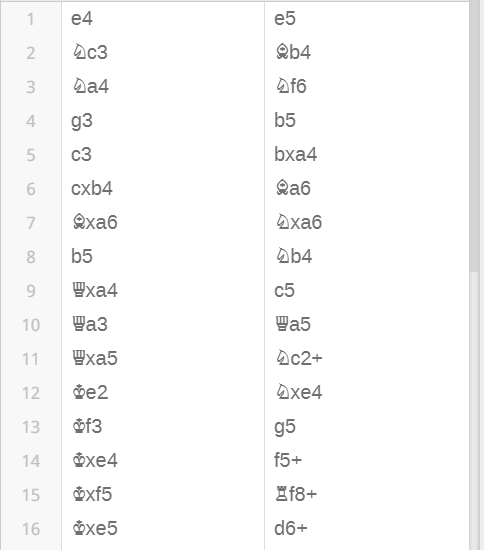
Here is an example of algebraic chess notation. There are other notations such as Forsythe, but algebraic notation is universally understood. Algebraic notation is often a letter (except the pawn) accompanied by the square (Column letter and row number). Each 'Move' contains a white move (recorded on the left) and black move (recorded on the right). Overall, learning about chess notation has helped me understand moves better.


The definition of tactic in chess is a single move or a series of moves that gives you an advantage (Eade 100). An example of a tactic is the fork. A fork is when you use one chess piece to threaten two enemy pieces. As you can see in the example my knight threatens both enemy pawns, which is a knight fork. Although, it's simple strategy it gives you a big advantage since your opponent can't always protect both pieces. So, how important do you think tactic is to chess?

Thursday, November 30, 2017

Chess: Don't Use Queen Raid

By: Alex Faull

How you open a game in chess can be very critical. If you open poorly you'll likely end up playing from behind for the rest of the game, but if you open ahead, then you could dominate your opponent and end the game being able to say checkmate. Now, me and many other bad chess players (yes, I am admitting that I am bad) become focused on the queen, which isn't to surprising since the queen is so powerful. Because of this focus people tend to use an opening strategy that Yasser Seirwan in the book Winning Chess - Openings calls Queen Raid. Seirwan describes the logical behind Queen Raid, "My Queen was a natural-born bully! All that was necessary was to introduce it into the game as early as possible"(Yasser, 8). The opening strategy is simple: get your queen into play as fast as possible, and use the queen to bully your opponent's weaker pieces. And it actually worked for him, but only when was newer to the game and playing against inexperienced players.


6th turn of one of Seirwan's early games (found on page 17).
The reason this worked for Seirwan at one point is simply because his opponents didn't understand how to counter it. Because of this he achieved many fast victories, being able to win the game without moving most of his pieces. But there is the problem: he never uses most of his pieces early, so they get simply stay trapped where they were from the start. So, when Seirwan began to use Queen's Raid against better opponents, they would use their own pieces to push bully his queen by constantly placing it under the threat of capture. So while Yasser spent the opening trying to try and keep his queen alive, his opponents would simply gain control of the board by having more pieces in play. The image to the right is from one Seirwan's games where the Queen Raid failed him (Seirwan is white, his opponent is black). While Seirwan has opponent in check, he is actually at the disadvantage. Though the aggressive Queen Raid opening put the black king in some danger, black already has both knights in play, two pieces in the center of the map, a threat against the white pawn in the center (black knight on f6), and can easily move out other pieces. White has a pawn in the center, the queen under threat, a check, and pieces trapped behind a wall of unmoved pawns. Check on turn 6 is very early, but a single check isn't worth being put behind this early.

The Queen Raid has the chance to secure an early win, but you can't rely on it. So, if it's unwise to go for an early win, what is wise? What do I want to accomplish with an early opening? In Yasser's words, you want to "control the center"(Seirwan, 26). This is the underlying principle of a good opening. The reason is simple, a piece in the center has more power since it can impact more vital spaces, allowing you to better control the map. For this reason, the following is one of the most common first moves of a chess game:

 White moves a pawn forward to e4, placing a piece in the center (outlined in red), making it a critical piece on the board
Pawn to e4, an incredibly common move.
Black responds to white by mirroring white and moving a pawn to e5, allowing black to also have a foothold in the center.
Pawn to e5, another incredibly common move.

The next few turns generally involve both side threatening the pawns in the middle, protecting them, and moving other pieces into the center if given the opportunity. Though this is very common and simple, what ensues after is where the incredibly complicated parts come in, but I'm still early in the book, so I won't even act like I know what I'm doing.

I decided to try a both the Queen Raid opening and an opening based on controlling the center against a chess AI. I was crushed, every game (don't judge me, those AI's are terrifying). While I was getting crushed I did notice something: Seirwan was right about the two strategies. I tended to last much longer when I focused on the center and not my queen, being able to have some influence over the board, while when my queen was the focus I could do basically nothing but run from the enemy. So, now that we have an idea of what openings should do, next time I will begin to answer the question: How does one control the center with an opening?

Monday, November 27, 2017

Chess: Typical Openings


Eade, James. “Exploring the Elements of Chess.” Chess for Dummies, For Dummies, 2016, pp. 39–42.

Before starting the book Chess for Dummies by James Eade, I had no clue on how to play chess. Sure, I may have known how pieces moved from playing on the chess program that's sometimes pre-downloaded on the laptop but that was it. With no chess knowledge on strategy or combinations I lost to computers in chess almost every single time.

After reading the first 5 chapters of the book, I've learned a lot more about chess. One of the tips that caught my eye was this, "The battle for space is fiercest in the center of the board. Controlling squares e4, e5, d4, and d5, as well as the squares adjacent to them, is like seizing the high ground in a skirmish" (Eade 40). Space is extremely valuable in chess, as chess is a game of "Spacial conquest" (Eade 39). Space can force you or an opponent into a cramped position leading to checkmate. I followed the tip and began with a with this opening. Two pawns and two knights forward, competing for the area in the center.

In this position, I realized how much control over space I had. My knights and pawns could easily capture any enemy piece that wandered too far. The bishops in the back row were free, not blocked by my pawns. Before attempting this opening, I never realized pawns blocked the potential of other pieces or the fact that some pawns should specifically be moved first. Pawns on the "wings" or sides of the board should not be moved first, pawns blocking pieces that move diagonally should be removed first to gain control in the "opening" stages. Although I lost this game, I gained some understanding on how moves could compliment other pieces and how space is essential in winning.

Question: Have you ever learned something crucial through actual practice rather than reading?


Sunday, January 29, 2017

Making Sacrifices

Making Sacrifices

Hey guys!

For my last post I wanted to go over important things I learned from reading Yasser Seirawan's book and share the final thing I learned. When I did my first blog a couple months ago I knew nothing about chess except the basic rules. I did not know of the countless strategies players could use to there advantage and how hard the game really was. Now I am feel confident enough to call myself a good chess player and its all thanks to Yasser Seirawan and his amazing book. The most important think I think I learned from reading his book is that anyone can become a great chess player if they try hard enough.
The final thing I learned from reading Yasser Seirawan's book is that you must sacrifice key pieces if you want to win. One strategy I learned was the Queen sacrifice tactic which is when you sacrifice your queen in return for tactical or positional compensation. A lot of times a queen sacrifice at the right time can lead to a quick checkmate. In the picture below you can see that by letting the opponent take my queen it distracted him and I am able to get near his king.

 
This is a very risky Strategy to use against very good players since they will be able to see that you want them to attack the queen however when playing against a casual player sacrificing the queen is a very good strategy because they will want to attack the queen the first chance they get.

How do you think Sacrificing a players own pieces can benefit them?


The X-ray Tactic

The X-ray Tactic

I'm back and I just wanted to let you know how progress is going. Chess has gotten much easier for me and I have made a lot of improvement to my game thanks to Yasser Seirawan. His tips have been very helpful to me in getting better at chess.
In his book he talks about the X-ray tactic and its a very interesting way to look at chess and can be very useful. This tactic allows for a piece to start an attack even when other pieces are in the way and also allows a piece to defend a friendly piece while attacking the enemy piece in the process.

In this positon below the white piece has placed the bishop where he can execute the X-ray attack. When the bishop attacks the queen she will be moved but the rook will remain under the bishops watch. Its like attacking the rook through the queen and once the queen has moved the rook will be captured. This is a great example of the X-ray tactic because you are able to attack the enemy through the body of another. This is also a very good tactic because it puts the king in danger of a checkmate.

One of Yasser Seriawan's greatest quotes when it came to the game of chess is "Though most people love to look at the games of the great attacking masters, some of the most successful players in history have been the quiet positional players. They slowly grind you down by taking away your space, tying up your pieces, and leaving you with virtually nothing to do". this is a very strong quote and it can also relate to the X-ray tactic because its a tactic that leaves you with virtually nothing to do.

How has the X-ray tactic changed your view of chess?

Monday, January 23, 2017

Take No L's


Winning Chess

Its been a while since my last post and I am really starting to understand the rules and mechanics of the game. I've started to play against other people online and its been very fun trying to beat really good players. I'm a very competitive person and have been for a very long time now, so I hate to lose when I play against people. In this blog post I will be showing you some of the new moves I've learned to make sure you never lose while playing chess.

Everyone knows that the most important part of chess is getting checkmate. Some people struggle to ever get a checkmate and some do it without breaking a sweat. Getting a checkmate can either take hours or minutes to accomplish. One of the most deadly checkmates in chess is known as the back rank.

In the book winning chess: strategies Yasser Seirawan brings up a checkmate known as the back rank which if done right, can do some serious damage. This checkmate is delivered by the Rook or Queen along a back rank where the King is unable to move because it is blocked by friendly pieces.

In this picture you can see that I was clearly a
victim of the back rank checkmate. My king is in the very back with no options. I am unable to move forward in anyway because my own friendly pieces are blocking my way. The only move I can make is move my queen next to the Rook blocking its way to my king However after the Rook takes down my Queen its checkmate.

This is one of the most common mistakes made by rookie players because they worry to much about protecting the king often leading to the king being surrounded by its own friendly pieces leading to the king having no way to escape.

Have you ever been a victim of the back rank checkmate and what do you think is the best way to prevent it from happening?

Sunday, January 1, 2017

Attacking the knight

More Winning Moves

I have continued on my adventure to get better at Chess and throughout the book I have found even more cool unique moves to help me win. I have found much more challenging starting moves and wanted to see if they really work.

I haven't been doing to much out of my IRP book other then figuring out which moves work the best and a great move is by attacking the other players knights first because they are very important in the game of chess.

I have been trying many ways of attacking the knights by playing against the computer and I have made a lot of progress in figuring out the best method. this picture shows how the book describes the game should go if you do everything correctly. I have found many different methods of attacking the knight and the best is the one below
as you can see I was able to take down the knight and this will allow me to ultimately gain a huge advantage over the other player  

question: how is attacking the opponents knight first help give a player the advantage


Wednesday, November 30, 2016

Learning Chess

Chess starting moves


Chess has been something I have always been interested in learning and that why I chose to do greatest chess strategies as my IRP project. Chess has 3 phases: the opening, the middle game, and the endgame. In the opening pawns and minor pieces play very key roles.

There are 10 useful tips to help you succeed in the game
  1. Look at your opponent's move.
  2. Make the best possible move.
  3. Have a plan.
  4. Know what the pieces are worth.
  5. Develop quickly and well.
  6. Control the center.
  7. Keep your king safe.
  8. Know when to trade pieces.
  9. Think about the endgame.
  10. Always be alert.


I believe the best way to get started is with a good first move because often times the first move can decide everything that is why I will be focusing on opening moves in the first blog. In the book the book it says one of the best first moves is to attack the e5 pawn by doing so your opponents choices are very limited. This is the best opening move and the easiest to pull off

another great move to open with is called the "Spanish opening" which starts out by making 3 unique moves. shown in the picture to the right are the 3 moves White creates a potential pin of the d-pawn or Knight and starts an attack immediately, this is a very useful move to make.
Question: Do you think your opponents moves can effect how these moves are used or will you still be able to perfom them successfully?